Thin film barriers have been employed to impede the diffusion of Cu into surrounding intermetallic dielectric materials, preventing the degradation of device performance.1 With the increasing complexity of device architectures, the demands for the metal diffusion layer have also grown more stringent, such as high thermal stability, low resistivity, low deposition temperature (<500 °C), and high conformality over 3D features. Since there is an absence of reactions between tungsten and copper or nitrogen and copper, tungsten nitride (WNx) thin films have been determined as a promising candidate for metal diffusion barrier application.
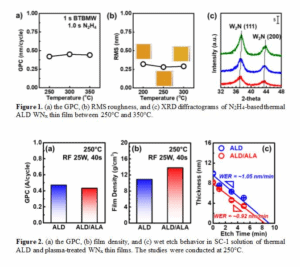
This study focusses on the atomic layer deposition of WNx thin films anhydrous hydrazine (N2H4, room temperature) and bis(tebutylimino)bis-(dimethylamino)tungsten (VI) (BTBMW, 85°C). In the study, a nearly constant growth rate of approximately 0.045 nm/cycle was observed across a temperature range of 250°C to 350°C, indicating a well-defined ALD temperature window. X-ray diffraction (XRD) analysis reveal that the N2H4-based WNx thin film are polycrystalline, with distinct peaks at 37.5° and 43.7°, corresponding to (111) and (200) planes of the face-centered-cubic (FCC) W2N.3 Notably, despite their crystalline nature, the deposited WNx films exhibited excellent surface smoothness, with a root-mean-square (RMS) roughness as low as 0.29 nm, underscoring the conformality and quality of the deposited coatings.
Furthermore, to maintain the high growth rate of the thermal ALD process while enhancing thin film properties, we explored the effects of Ar plasma annealing during the deposition of WNx thin films. Specifically, an Ar plasma step with RF power as low as 25 W was introduced after each complete ALD WNx cycle. At the deposition temperature of 250 °C, the growth per cycle (GPC) of the plasma-treated films decreased by approximately 10% compared to the standard thermal ALD process, likely due to plasma-induced densification. XRD analysis showed a further increase in film crystallinity with plasma treatment. Additionally, the film density increased by approximately 26%, which corresponded with enhanced wet etch resistance in SC-1 solution. Although a slight increase in surface roughness was observed due to plasma bombardment, the RMS value remained below 0.4 nm, preserving overall film smoothness. These results demonstrate the effectiveness of incorporating plasma annealing into thermal ALD processes to engineer high-quality WNₓ thin films.